Gummy Drop! Match 3 & Travel
- 4.5
- Rating
- 10.00M
- Installs
- Free
- Price

 Analysis by App-foxy
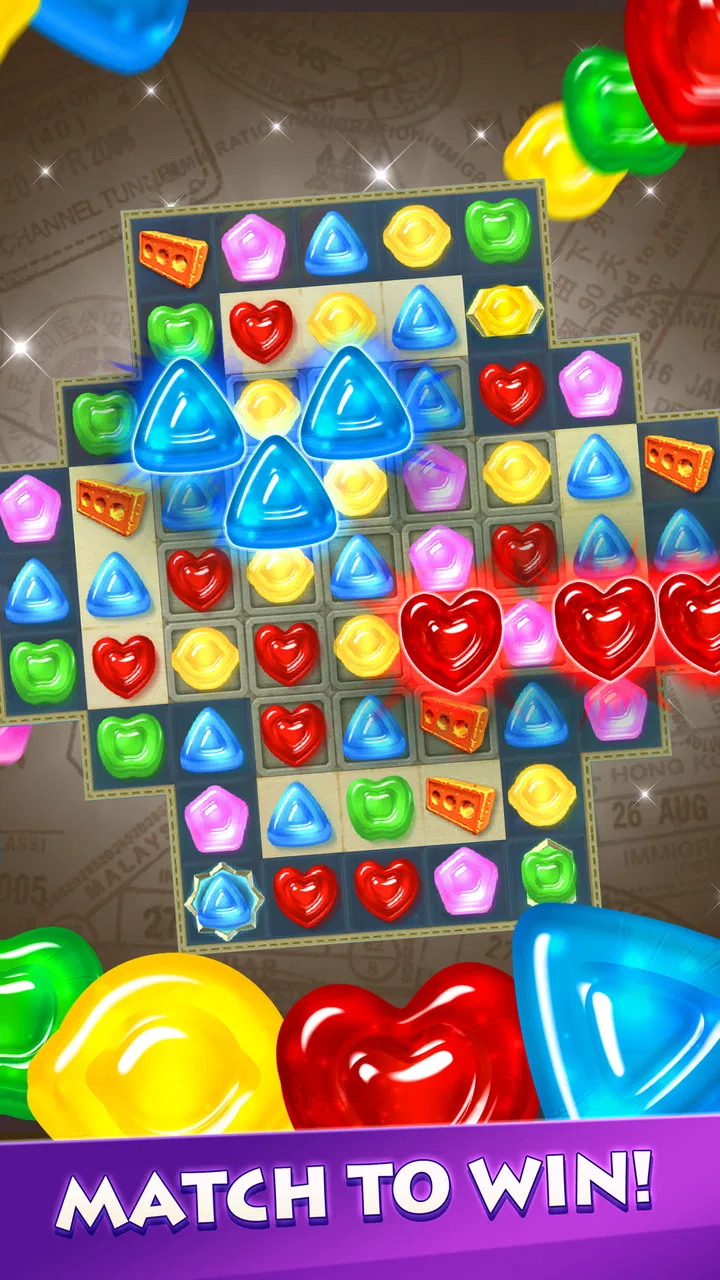
I have always liked match-three games that give me a reason to keep going beyond simply clearing another board. Gummy Drop! Match 3 & Travel takes that familiar format and connects it to a journey through cities, so each short puzzle feels like part of a larger rebuilding project. After spending time with it, I found a game that is easy to understand, pleasant for brief sessions, and more strategically demanding than its colorful presentation first suggests.
The basic idea is approachable: match pieces, complete objectives, earn progress, and use that progress to restore locations as you move through the game. The travel theme gives the levels a sense of direction, while the candy-like presentation keeps the mood light. It is free to download and aimed at Everyone, making it a natural choice for families, casual players, and anyone who wants a puzzle game that can be played in small pieces throughout the day.
How the current game feels to play
The strongest part of the experience is the balance between immediate action and longer-term progress. A board can usually be understood within seconds, but finishing a stage often requires more than making the first available match. I found myself checking the layout before moving, looking for combinations that could open space or create stronger effects rather than clearing pieces randomly.
You May Also Like

 Blood Strike: 2.5 Anniversary
Blood Strike’s Loadouts Turn Every Drop Into a Tactical Gamble
A close look at Blood Strike’s custom loadouts: how fast access to signature weapons reshapes its battle royale rhythm, rewards preparation, and narrows the gap between fights.

 Pandora - Music & Podcasts
Pandora’s Music Is Easy to Start, but Harder to Recover
Pandora’s strength is its low-effort path from a seed to a station. Its weak spot is how much confidence it asks you to place in connection, setup, and quiet recovery.

 8 Ball Pool
 Is Built on Rivalries, Rematches, and Routine
A close look at the rivalries, rematches, shared routines, and unanswered safety questions that turn a quick pool match into a persistent mobile community.

 Samsung Music
’s Quiet Strength Is Playing What You Already Own
Its reach comes less from spectacle than from dependable access to a personal library. That simplicity is both the app’s strongest retention engine and its ceiling.

 AccuWeather: Weather Radar
AccuWeather Review: A Quick, Clear Forecast for Everyday Decisions
For everyday plans, the best forecast is the one you can understand quickly. AccuWeather makes rain timing, radar, and local conditions easy to act on, with a few trade-offs.

 Hill Climb Racing
Why Hill Climb Racing Still Turns Crashes Into One More Run
A tiny car, a bumpy hill and one more upgrade: Hill Climb Racing keeps resurfacing because its simple chaos makes every near-miss feel personal.
More From Our News Desk



That extra layer matters because the travel map gives individual levels context. A failed attempt does not feel entirely disconnected from the rest of the game; it is part of trying to improve a place and move forward. The structure works especially well when I only have a few minutes, because a single stage can provide a complete little session without demanding a long uninterrupted play period.
At the same time, this is still a match-three game at heart. Players who already feel tired of swapping colorful pieces may not find the city-restoration theme enough to change their opinion. The travel setting adds motivation, but it does not replace the familiar puzzle loop. I would recommend it to someone who enjoys that loop and wants a broader progression system, rather than to someone actively looking for a completely different type of puzzle.
The game comes from 7 Hits Games and has built a substantial audience. It holds an average rating of 4.5 from around 537 thousand ratings, with roughly 47 thousand written reviews and more than 10 million installs. Those figures suggest that the format has connected with many players, although popularity alone should not be confused with a perfect fit for every playing style.
A gentle start with more planning later
The early experience is friendly because the matching rules are immediately readable. I do not need a long explanation before I can begin making progress. That accessibility is useful for younger players and for adults who want something relaxing rather than a game that makes them study complicated systems before having fun.
As the boards become less forgiving, the best approach changes. I learned to protect useful spaces, avoid spending a powerful combination too early, and consider the level objective before chasing the largest-looking match. This is one of the more valuable lessons in the game: a visually impressive move is not always the move that solves the board.
That makes the game suitable for two different moods. I can play casually when I want to switch off, or I can treat a difficult stage as a small planning exercise. The experience is not a pure reflex test, and it rewards patience more than frantic tapping. Players who enjoy thinking several moves ahead will likely get more from it than players who only want constant, effortless wins.
What the travel structure adds
The city progression gives the game a useful sense of purpose. Instead of presenting an endless stack of unrelated puzzles, it frames progress as movement through recognizable destinations and restoration work. Even when the individual board follows a familiar formula, the larger map helps me remember why I am playing the next stage.
I also like how this structure creates natural stopping points. If I am waiting for an appointment or taking a short break, I can play a level and put the phone away without feeling that I have abandoned a complicated story. That makes it more practical than puzzle games that expect a long campaign session or constant attention to narrative details.
There is a trade-off, though. The travel concept can make progress feel more goal-oriented, but it may also encourage players to continue after they have stopped having fun simply because the next location is close. I recommend setting a personal stopping point, especially when a difficult level begins to turn a relaxing break into repeated frustration.
Changes reflected in the current version
The current version is 5.10.3, which places the game in a mature stage rather than at the beginning of its life. It was released on December 10, 2014, so the product has had a long period to establish its identity and refine the way its puzzle progression works. I see that maturity in the clear core loop: the game knows what it wants to be and does not bury the matching action under unnecessary complexity.
For someone returning after a long break, the most important expectation is not that it will feel like a brand-new puzzle concept. Its evolution is better understood as the continued development of an established travel-and-restoration format. The current build presents that formula as an ongoing experience rather than a short, self-contained game that is meant to be completed in one sitting.
The minimum operating requirement is Android 6.0, which is helpful for people using older compatible devices. Still, I would check the operating system on a particular phone or tablet before installing, especially if the device has been kept for many years. Compatibility is practical rather than exciting, but it can make the difference between a smooth installation and an unnecessary disappointment.
Because the game is free, trying it does not require an upfront purchase. Optional in-app purchases range from $0.99 to $99.99 per item, so I would approach the store carefully and decide in advance whether I want to spend anything. The free entry point is convenient, but the presence of a wide purchase range means the game is best enjoyed with a clear personal budget.
What returning players should know
Existing players are likely to appreciate the continuity of the core experience. If you enjoyed matching pieces while working through a map, the current build remains recognizable rather than replacing that identity with a different genre. That is good news for returning users who want to pick up where they left off without relearning an entirely new game.
My practical advice for returning players is to replay the early stages as a warm-up instead of immediately judging the current experience by a difficult level. The opening boards help restore the rhythm of scanning the layout, preserving useful moves, and choosing combinations with the objective in mind. Once that habit returns, later challenges feel more manageable.
It is also worth remembering that progress and enjoyment are not always the same thing. A player who has already completed a large portion of the map may find the remaining stages more demanding, while a new player may enjoy the steady sense of discovery. If the game starts feeling like a checklist, taking a break can help; the short-session design makes it easy to return without losing the entire appeal.
Small decisions that improve difficult boards
One of the less obvious strengths is how much the game rewards board awareness. I try not to make the first simple match automatically. Instead, I look for moves that create room, connect future matches, or remove the obstacle that is most likely to block the objective. This takes only a few seconds, but it reduces the number of turns wasted on attractive yet unhelpful moves.
Another useful habit is to work from the most restricted area of the board when possible. Open sections often remain available later, while a cramped section can become impossible to manage if ignored. The exact priority changes from level to level, but the general principle is reliable: solve the part of the board that limits your options before polishing areas that are already easy to reach.
I also recommend resisting the urge to use every strong combination immediately. A powerful move can be valuable because of its timing, not just its size. Saving it until it can affect the target area or combine with another useful effect may produce more progress than triggering it as soon as it appears. This is the kind of decision that separates a thoughtful attempt from a purely reactive one.
Finally, when I fail, I try to identify the reason rather than repeat the same opening. Was I clearing pieces without advancing the objective? Did I leave a blocked corner untouched? Did I spend a useful combination before the board was open? Treating a failed attempt as information makes the game feel less dependent on luck and gives the next try a clear purpose.
Where it fits in everyday life
A realistic use case is a commute or a lunch break where I want something engaging but not emotionally heavy. I can open the game, complete a few actions, and stop when I reach a natural pause. It also works well at home when I want a quiet activity alongside a podcast or television, although difficult boards may require more attention than the relaxed presentation suggests.
For families, the Everyone rating makes the tone approachable. Younger players can understand the matching concept quickly, while adults may enjoy the planning and progression. I would still keep an eye on purchase settings when a device is shared, because the free download includes optional items with prices that vary widely.
The game is less suitable for someone who wants a fully offline, story-driven adventure, a competitive multiplayer puzzle, or a short experience with a definite ending. It is also not my first choice for players who dislike energy-style pacing, repeated attempts, or any pressure to consider optional spending. A premium puzzle with a single upfront cost may be a better alternative for those users, while a minimalist match-three title may suit someone who does not care about maps and restoration.
How it compares with familiar alternatives
Compared with a basic match-three game, this title gives me more reason to care about the next level because the board is tied to a destination and a larger restoration journey. That added structure is its clearest advantage. A simpler alternative may feel cleaner and faster, but it can also become repetitive sooner if there is no broader goal beyond achieving a high score.
Compared with a premium puzzle game, this one is easier to try because there is no purchase required to begin. The disadvantage is that free-to-play design can make the overall rhythm feel less controlled, particularly for players who prefer paying once and receiving a complete, uninterrupted campaign. My choice would depend on priorities: convenience and ongoing progression here, or a more contained experience elsewhere.
It also differs from competitive puzzle games because the focus is personal progress rather than direct rivalry. That makes it calmer and more accessible, but it removes the pressure and excitement that some players get from leaderboards or live opponents. In my experience, the game works best as a solo companion for spare moments, not as a substitute for a competitive puzzle community.
Remaining friction and sensible expectations
The biggest limitation is repetition. Even with the city theme, the central activity remains matching pieces across a sequence of levels. Players who need constant mechanical novelty may eventually feel that the presentation is carrying a familiar system rather than transforming it.
Difficulty can also change the mood. A relaxed stage may become a sequence of retries, and the desire to continue toward the next destination can make those retries feel more important than they really are. I found that the best response was to pause, rather than immediately spend money or keep making identical attempts.
The purchase range deserves attention for the same reason. Free access is a genuine benefit, but optional items can become expensive at the upper end. I would recommend playing without purchases first, learning whether the pacing suits you, and only then deciding whether any optional spending adds enough value to justify it.
There is also a difference between accessibility and simplicity. The controls and rules are easy to grasp, but later planning can be demanding. Someone buying it for a child may find the presentation inviting while underestimating the patience required on harder boards. That is not a flaw by itself, but it is worth knowing before assuming every stage will be equally easy.
What I would watch before committing
If I were deciding whether to keep the game installed, I would pay attention to three things during the first sessions. First, do I enjoy the basic matching action even when the city-restoration goal is removed? Second, do I find the map motivating rather than distracting? Third, can I accept the free-to-play pacing without feeling pushed toward optional purchases?
I would also watch how the current version behaves on my particular device. The Android requirement reaches back to version 6.0, but hardware age, screen size, and available storage can still affect comfort. A larger display may make board planning easier, while a smaller phone can make extended sessions less pleasant even when short sessions work perfectly well.
For returning users, I would look for whether the established progression still gives a satisfying reason to replay or continue. The game’s long history is reassuring in terms of identity, but it also means the experience is designed around an ongoing journey rather than a dramatic reinvention. That is a strength if you want familiarity, and a weakness if you are waiting for a radically new puzzle format.
My overall view is positive, with clear conditions. This is a good pick when you want approachable match-three puzzles connected to a longer travel-themed goal. I like its short-session convenience, its gentle entry, and the way careful planning becomes more important as the boards challenge me. I would skip it if I wanted a one-time premium purchase, a competitive mode, or a puzzle system far removed from traditional matching.
For most casual Android players, the free starting point makes it easy to test that fit for themselves. The Everyone rating and familiar controls lower the barrier to entry, while the current 5.10.3 build represents a mature version of the game’s established direction. Just keep expectations realistic, use a spending limit, and remember that the most satisfying progress usually comes from studying the board rather than rushing through it.
FAQs for Gummy Drop! Match 3 & Travel
01What is the main objective of Gummy Drop! Match 3 & Travel?
Gummy Drop! Match 3 & Travel is a puzzle game where the main objective is to match three or more gummies of the same color to complete various levels. As players progress, they embark on a journey to rebuild famous landmarks around the world, combining engaging gameplay with a travel-themed adventure.
02Are there in-app purchases in Gummy Drop! Match 3 & Travel?
Yes, Gummy Drop! offers in-app purchases that can enhance gameplay by providing additional lives, boosts, and other helpful items. While the game is free to download and play, these purchases can help players progress more quickly through challenging levels.
03Can I play Gummy Drop! Match 3 & Travel offline?
Gummy Drop! requires an internet connection to play. This online requirement allows players to access regular updates, new events, and synchronize progress across multiple devices. Playing online also enables participation in global leaderboards and community events.
04How does the travel aspect work in Gummy Drop! Match 3 & Travel?
The travel aspect of Gummy Drop! is integrated into the gameplay by allowing players to rebuild famous landmarks in different cities around the world. Each city offers unique levels and challenges, encouraging players to explore and learn about various locations as they advance.
05Is Gummy Drop! Match 3 & Travel suitable for all ages?
Yes, Gummy Drop! is designed to be enjoyed by players of all ages. Its colorful graphics and straightforward mechanics make it accessible for younger players, while the increasing difficulty and strategic elements offer a satisfying challenge for older audiences. Parental guidance is recommended for in-app purchases.
Pros
- Engaging puzzles keep gameplay fresh.
- Vibrant graphics enhance travel themes.
- Frequent updates with new cities.
- Easy to learn for all ages.
- Offline play available for convenience.
Cons
- In-app purchases can be pricey.
- Some levels feel repetitive.
- Requires significant storage space.
- Occasional connectivity issues.
- Energy system limits playtime.

Gummy Drop! Match 3 & Travel
Gallery